October 5th, 2026 — Monthly Meeting
Builder night and our first Monday-night AIMUG. The talks covered routing requests across a mixture of models, calibrated decision models for agent workflows, evals for coding-agent harnesses, a spec-driven "coding factory," and graph-based dependency tracing. The thread through all of them: use the smallest thing that does the job, and measure it.
Event Details
Date: Monday, October 5th, 2026
Format: Monthly meeting, in person plus Zoom, with lightning-style talks (~15–20 min) and Q&A
Host: AIMUG with CGCS (Center for Government and Civic Service)
Recording: Recording will be linked here once archived.
Talks
Mixture of models and semantic routing
Speaker: Colin McNamara
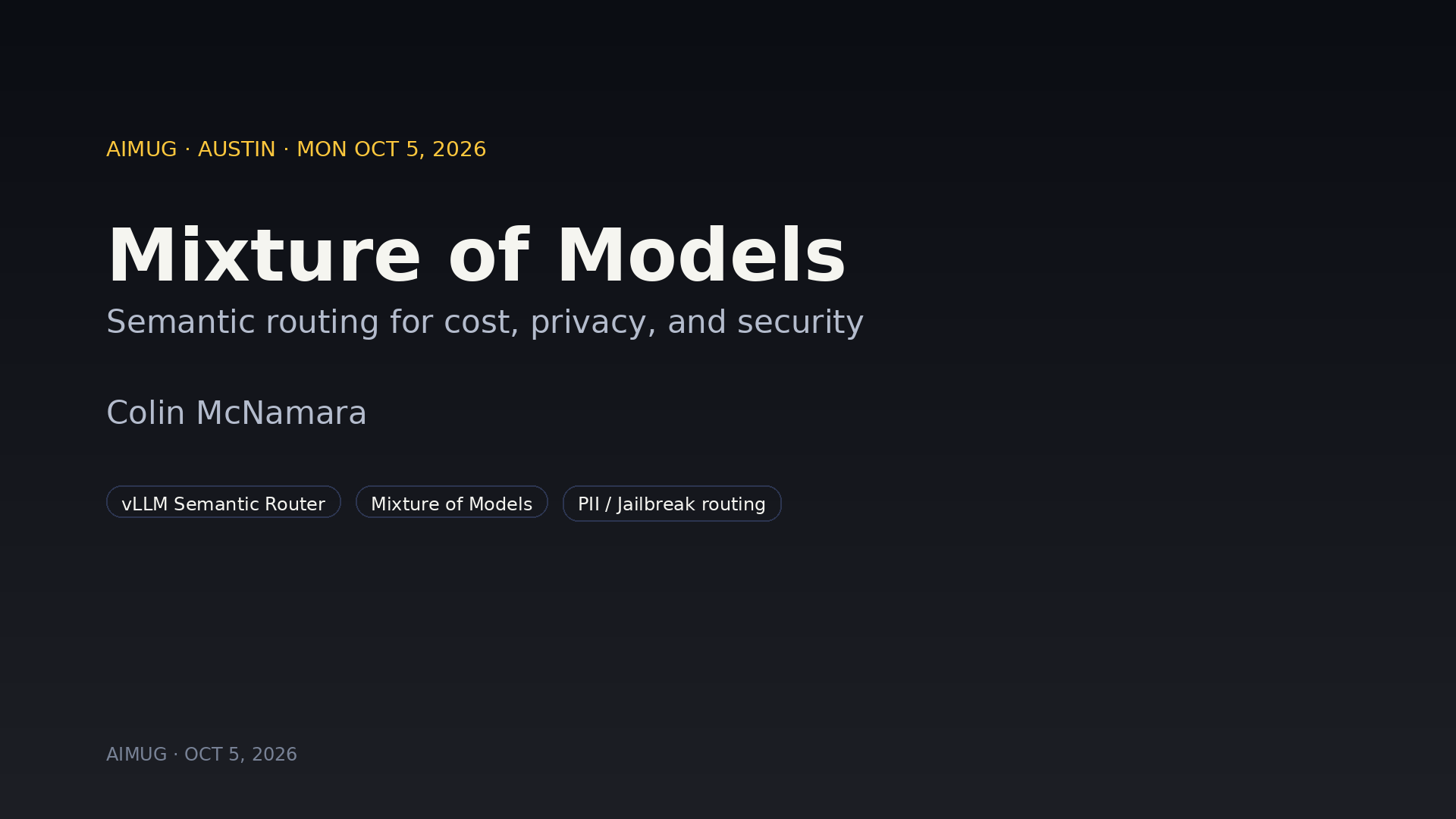
Slides: Mixture of Models
Project: vLLM Semantic Router
Sending every request to one model costs more, weakens privacy, and widens the prompt-injection surface. A mixture of models exposes one blended API and routes each request by policy: local model for tiny or private work, an open-weights mid-size model, or a hosted frontier API.
- vLLM Semantic Router presets: balanced, cost-optimized, speed-optimized, accuracy, privacy.
- Route by complexity, PII, or jailbreak signals. Send suspected injections to a tool-less logging model (a honeypot). Turn thinking off dynamically, reuse cached answers, and escalate to a bigger model only when confidence is low.
- Defense in depth: the primary control lives in the agent graph (LangChain/LangGraph middleware, PII masking, guardrails). The router adds a secondary point for enforcement and logging.
- The stack: gateway (Envoy / Agent Gateway) → semantic router → KV-cache-aware fan-out (llm-d) → model. NVIDIA Switchyard hooks in earlier.
- Rough laptop latency: about 240 ms at session start for vLLM Semantic Router, about 1 s for Switchyard.
- Anthropic
v1/messagessupport was missing across routers. Colin is filing bugs and PRs upstream, and some merged vLLM fixes are already moving into downstream packages. - Takeaways: start with middleware in your graph, add a router as a secondary control (Kubernetes or a local container), and turn on OTEL at more than one point so you can compare.
- Follow-up: test whether PII and injection protections stay active after routing, and patch if not.
Grokbot and JEV, a decision model
Speaker: Joseph Fluckiger
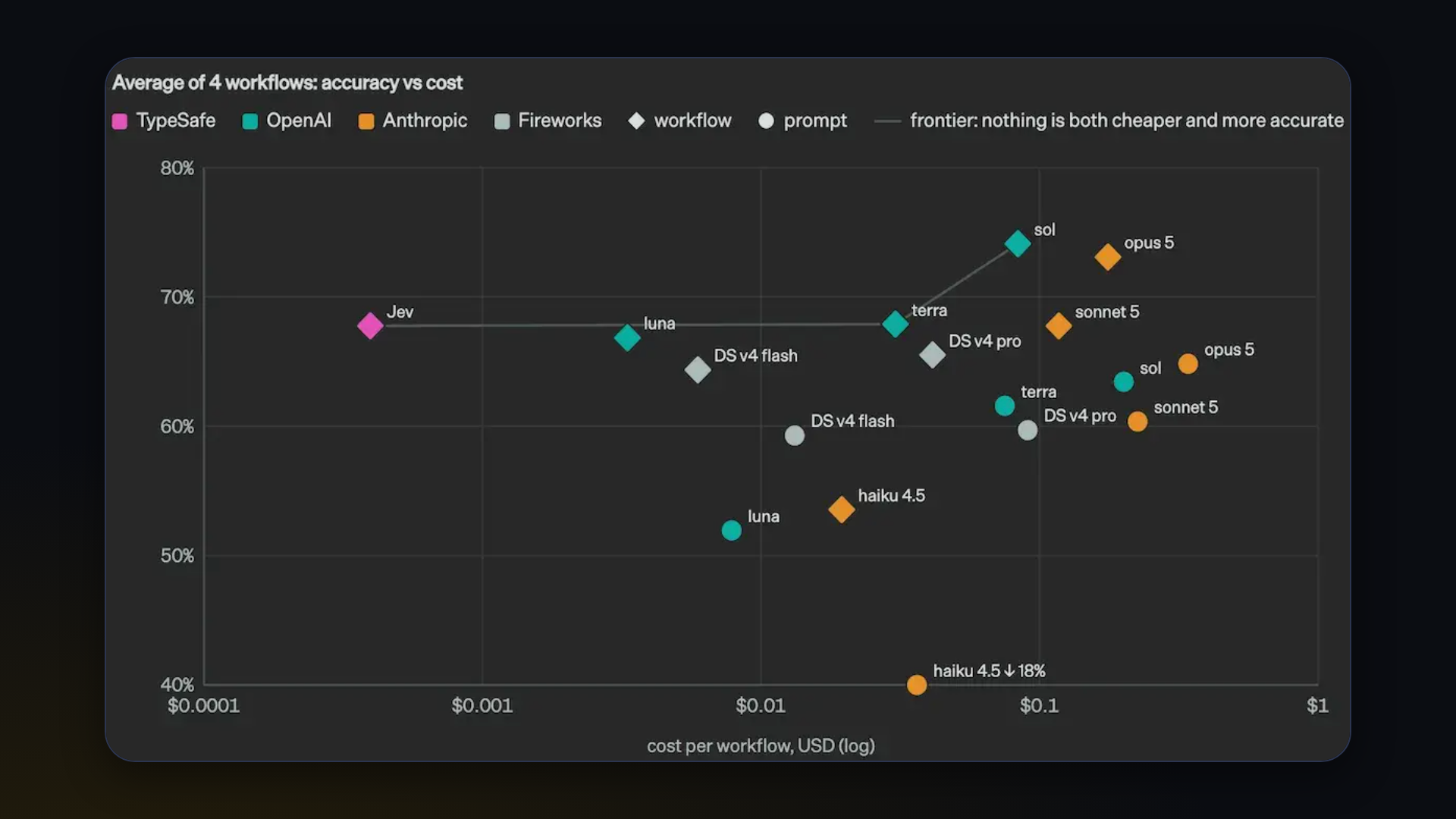
Slides: Joseph’s deck — GrokBot and Jev
- Personal agents: Grokbot (hosted VM, quick setup, works well on a phone including 2FA logins, agents hand off jobs to each other) versus self-hosted OpenClaw or Hermes (pick any model, local-only integrations like iMessage). His uses: calendar, email, Strava, an Obsidian vault, a fitness coach.
- JEV is a classification model, not an LLM, trained for calibrated decisions, so its probabilities are meant to match reality instead of being LLM self-estimates. Named after the Jevons paradox. Output types: choice, score, boolean.
- LangGraph use cases: golden Q&A matching instead of a RAG round trip, concierge sub-agent routing (about 600 ms versus about 4–5 s with a small LLM), fraud triage.
- His own tests: about 7–10× faster and 10–100× cheaper than a small LLM. Still a prototype, not in production.
- He recommended MLflow tracing, alongside LangSmith and Langfuse.
- Follow-up: prototype JEV on eBay fraud-agent workflows and measure latency and cost.
Harbor evals for coding agents
Speaker: Jeff Linwood
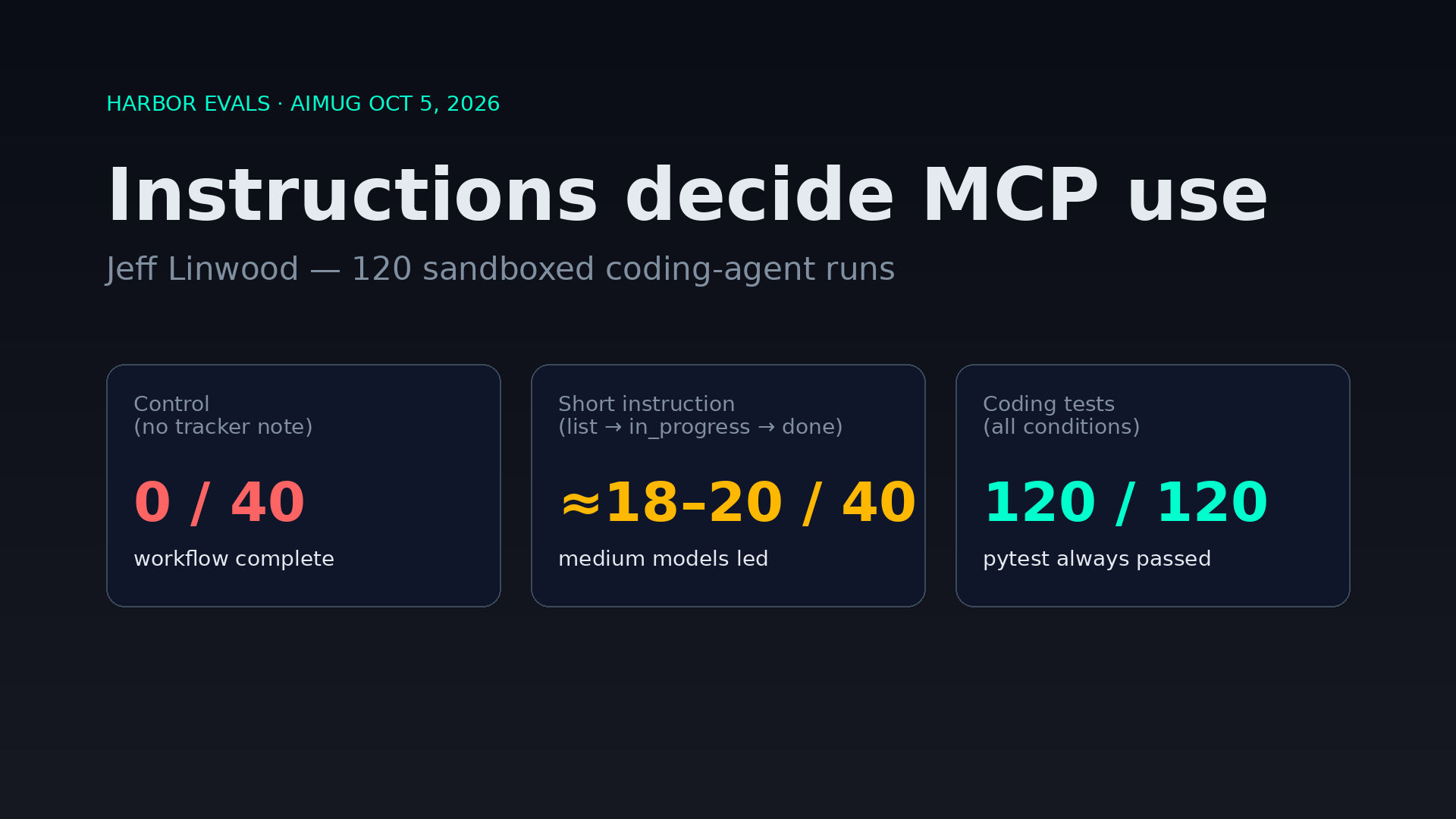
Slides: Agent evals with Harbor
- The problem: coding agents ignored the MCP task-board tools in his macOS agent workspace and fell back to grep.
- Harbor (open source, from the Terminal-Bench team) breaks an eval into task folder (
instruction.md, environment, tests), agent under test, model, verifier, and trials. It runs locally in Docker or on Daytona. Jeff used API keys instead of subscriptions. - Experiment: 120 runs covering 5 fixtures × Claude Code/Codex × small/medium tiers × 3 conditions (none, short instruction, the long instructions shipped in the Mac app).
- Results: all runs passed the coding tests. The control didn't use the tools. The short instruction got 10/10 (Claude Code, medium) and 8/10 (Codex, medium). The shipped long instructions got about 0–3/10. Small models did worse than medium.
- Takeaways: A/B test your
agents.md, design MCP tool names and descriptions with evals, and build an internal agentic-coding benchmark. - Follow-up: the next Mac app version ships the short instruction.
The coding factory: canonical specs and sequential agents
Speaker: Jake Cukjati
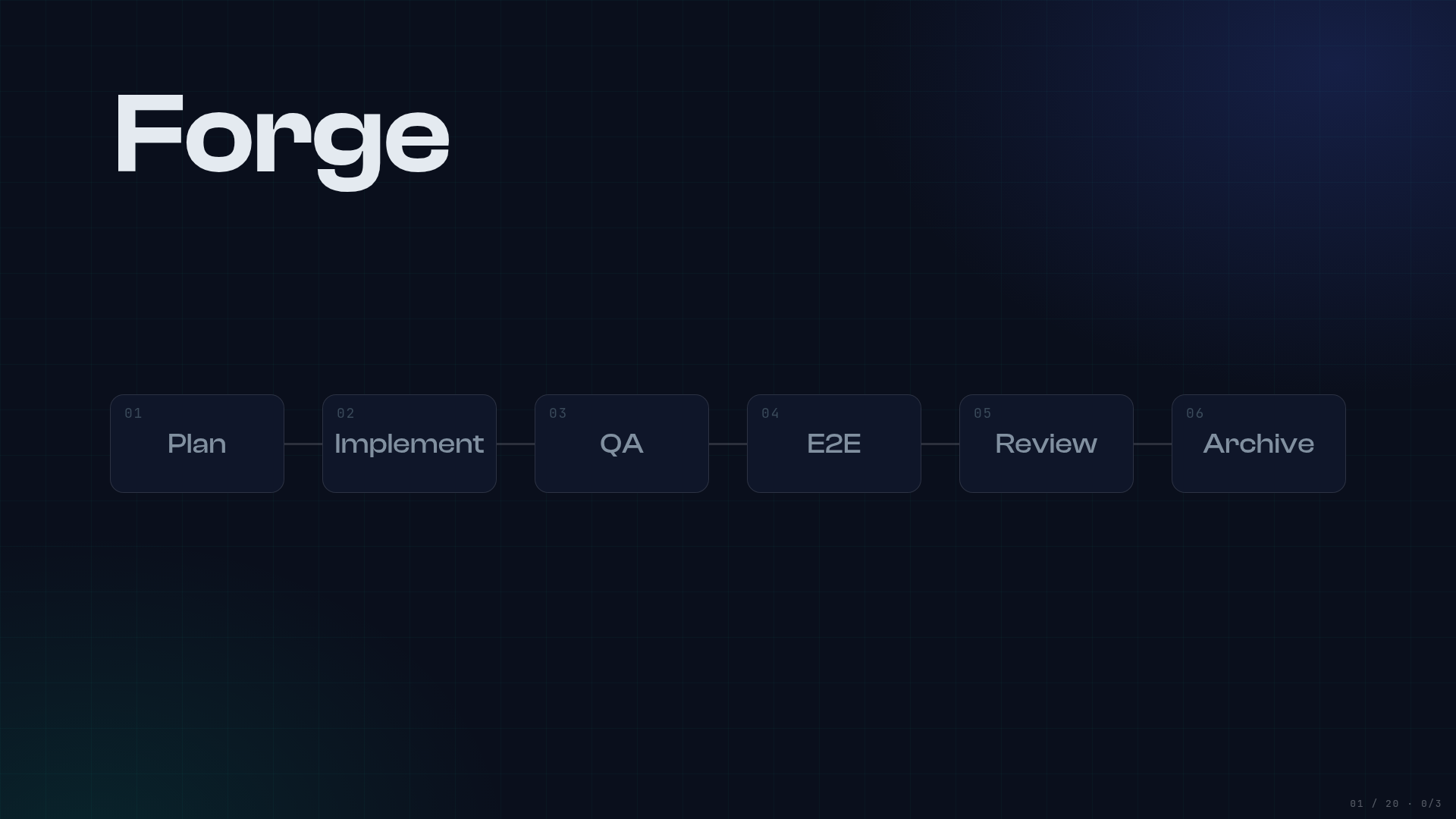
Slides: Forge with Rigor
- Stop prompting agents to write code. Have them work from specs. Runs now last hours (his longest was about 23.8 h).
- Specs are canonical and verifiable. Agents check them when they hit a bug, and Jake reviews specs instead of every line.
- The loop: specs → implementation → integration/E2E testing → code review → triage → compounding (reference material that feeds the next run).
- Sequential agents, one feature at a time, with structured handoffs. No parallel swarm.
- Context discipline: the largest agent context is about 330K tokens, with a soft target of about 250K. CLIs act as prompt engines that hand the agent the right context at the right time.
- Scale: 80–90 specs of 400–500 lines each (under 1,000). A commit-pinned manifest and a scheduler create batches that record the commit hash, files, and blockers. He plans a domain split as the codebase approaches 200K lines.
- Follow-up: open-source the skills and CLI once the test-harness rigor is where he wants it.
Korvik AI: graph analytics and dependency tracing
Speaker: James Coffey
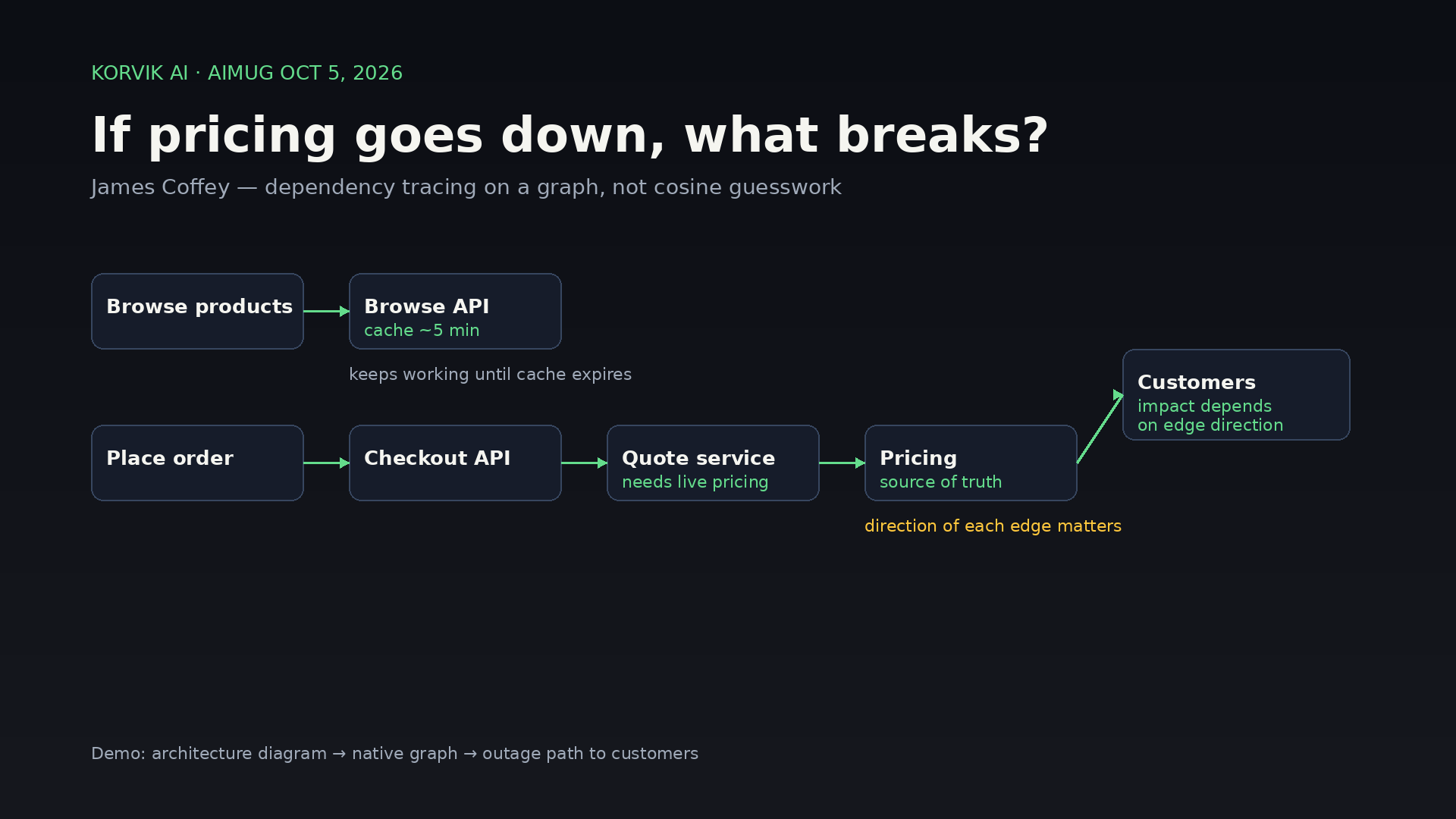
- Graphs keep and enforce relationships that embedding plus cosine similarity loses. Direction of dependency matters.
- Demo: Korvik read an architecture diagram image, built a graph, and traced what breaks when pricing goes down. The quote path breaks right away; browsing survives until its ~5-minute cache window runs out.
- Platform: rooms, live apps, templates and playbooks, MCP access, pipelines, embeddings and clustering.
- Fits: engineering prints, financial and parts lineage, medical ontologies and drug interactions. Compare against LlamaParse and Neo4j. For small graphs, something simpler is probably fine.
- Disclosure: James knows the team. Korvik is an early seed-stage startup.
- Follow-up: demo access for interested attendees. Credits are possible, but terms aren't final.
Closing
This was the first Monday-night AIMUG, noted by our CGCS host. The after-party moved to The Tavern's upstairs patio.
Resources
- Colin McNamara — Mixture of Models
- Joseph Fluckiger — GrokBot and Jev (deck)
- Jeff Linwood — Agent evals with Harbor
- Jake Cukjati — Forge with Rigor
- Blog recap: /blog/october-2026-monthly-meeting-recap
- Office hours: Tuesdays, 5–6 PM CT (link in Discord)
Next Steps
- Recording will be linked here once archived
- Community: post to Discord and Meetup once the public page is live